


On October 1, 2025, the board of Corteva announced a decision that was both seismic and, for those watching the numbers, entirely predictable. The agricultural sciences giant is to be cleaved in two. By the latter half of 2026, pending the usual regulatory choreography, a single entity will become two independent, publicly traded companies: "New Corteva," housing the Crop Protection business, and "SpinCo," which will control the Seed business.
The official rationale, delivered by CEO Chuck Magro, is that the markets for seeds and crop protection have "evolved" and their respective opportunities are "diverging." This is the sort of clean, forward-looking narrative that populates press releases. It suggests a proactive response to new market dynamics.
My analysis suggests a different, more fundamental driver. This isn't about markets suddenly pulling apart; it's a delayed acknowledgment of a structural reality that has been evident in the balance sheet for years. This is a financial maneuver, an exercise in decoupling two fundamentally different business models that were likely creating a valuation drag on one another. To understand the split, one must ignore the narrative and follow the assets.
The raw numbers provide the first clue. This is not a division of equals. SpinCo, the seed entity, is projected to have 2025 net sales of $9.9 billion, representing 56% of the parent company's total. New Corteva, the crop protection business, will account for the remaining $7.8 billion, or 44%. The total enterprise value is about $17.7 billion—to be more exact, the sum of those projected sales gives us a $17.7 billion top line that is now being partitioned. The larger slice, both in revenue and arguably in brand equity, is being spun off into a new entity.
And that brand equity is substantial. SpinCo will become the home of the Pioneer® brand, an agricultural colossus with a century of history baked into its identity. It also inherits regional powerhouses like Dairyland Seed® and Brevant®. New Corteva is left with the chemical portfolio. While significant, it lacks the deep-rooted, multi-generational brand loyalty that Pioneer commands in the field.
This is where the story pivots from a simple financial report to a case study in corporate incentives.
The CEO's Forwarding Address: A Signal in the Noise
Following the Money and the Mandate
When a company splits, the most telling data point is often where the incumbent leadership chooses to go. It’s a clear signal of where they believe the future value, and thus their own legacy, will be created. In this case, current Corteva CEO Chuck Magro will become the CEO of SpinCo. The current chair, Greg Page, will remain as chair of New Corteva.
I've looked at dozens of these spin-off filings, and it's always illuminating to track where the sitting CEO lands. The choice is rarely sentimental. It is a calculated bet on growth. Magro is not staying with the legacy corporate name; he is following the larger revenue stream and the marquee brand to the new entity. This action speaks more forcefully than any press release about "diverging opportunities." It suggests a belief that the Seed business, once unshackled, has a more compelling growth trajectory.
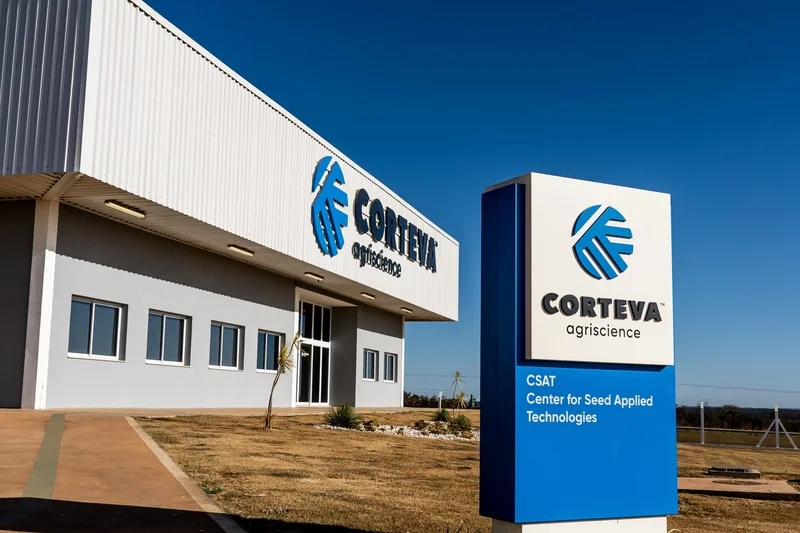
Let’s deconstruct the strategic roadmaps laid out for each new company.
SpinCo's stated focus is on "advanced genetics," "out-licensing," "hybrid wheat," "biofuels," and "gene editing." This is the language of a high-growth technology and intellectual property firm. It’s a business of patents, R&D, and high-margin licensing agreements. Its primary asset is genetic code, a product that can be scaled with minimal marginal cost.
New Corteva, in contrast, will focus on an "optimized supply chain," "operational excellence," and "sustainable innovation" including biologicals. This is the language of a mature industrial and chemical manufacturer. It’s a business of physical production, logistics, and managing input costs. Its success hinges on efficiency and squeezing margins out of a capital-intensive process.
The "divergence" Magro speaks of is not a recent market phenomenon. It is a fundamental, long-standing difference in business models. One is a tech company that happens to operate in agriculture; the other is an industrial chemical company. For the past six years, Corteva has been trying to manage both under one roof, undertaking portfolio simplifications and cost reductions. This split is the final admission that the synergies were illusory. A company trying to maximize R&D for gene editing operates on a completely different set of metrics than a company trying to optimize a chemical supply chain.
The market has likely been penalizing Corteva with a "conglomerate discount" for this very reason. Investors struggle to properly value a company with two disparate models. How do you assign a price-to-earnings multiple to a hybrid entity? Do you use the higher multiple typical of a tech/IP business or the lower multiple of an industrial manufacturer? Invariably, the market compromises, and the valuation of the whole is less than the potential sum of its parts.
The split is designed to solve this valuation problem. By creating two pure-play companies (the transaction is, conveniently, intended to be a tax-free spin-off for shareholders), the market can now value each one on its own distinct merits. My hypothesis is that the board expects the standalone SpinCo, with its high-tech narrative and Pioneer brand, to command a significantly higher valuation multiple than the combined entity ever could. New Corteva will be valued as a stable, cash-generating industrial, appealing to a different class of investor.
Details on the internal deliberations leading to this decision are, as expected, scarce. We are left to interpret the output. The output is a logical, if overdue, act of financial engineering. It is not a visionary pivot but a rational correction. The split isn't creating a new strategy so much as it is liberating two existing, and conflicting, strategies from one another. The real work for investors begins now: modeling two separate futures, two separate balance sheets, and two separate management theses. The data we have so far, however, points to one being a bet on growth and the other a bet on stability. And the CEO has already shown us which hand he’s playing.
---
The Inevitable Decoupling ###
This isn't a story of strategic genius. It's a story of subtraction. For years, Corteva has been a mathematical equation where one plus one equaled something less than two. The split is an admission of this fact, a necessary decoupling designed to let two different businesses be judged on their own terms. The "diverging markets" narrative is simply the public-facing justification for a decision rooted in the cold, hard logic of shareholder value and P/E multiples. The most honest data point in the entire announcement wasn't a number; it was the CEO's new forwarding address. He's moving in with the seeds.
Reference article source: