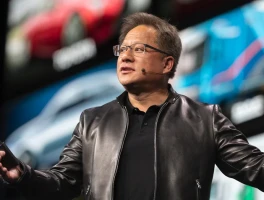


You’ve probably heard the phrase bouncing around the tech world, a soundbite carrying the weight of a paradigm shift: AI is in a “virtuous cycle.” The words are often attributed to Jensen Huang, the leather-jacketed visionary at the helm of Nvidia, and they feel right. As a CNBC report explains, Nvidia CEO Jensen Huang says AI is in a ‘virtuous cycle.’ Here’s what he means. They resonate with the incredible velocity of change we’re all witnessing. But when you go looking for the deep-dive, the specific transcript of that moment, the details can be surprisingly elusive.
And you know what? I think that’s a gift.
It forces us to move beyond just reporting on a CEO’s comment and instead to grapple with the titanic idea itself. Because this concept, this “virtuous cycle,” isn’t just some corporate buzzword about selling more GPUs. It’s the blueprint for the next century. It’s the engine that is beginning to reshape not just our technology, but the very definition of human potential. We are living inside the feedback loop, and I believe we have a moral and intellectual obligation to understand the incredible machine we’re building.
The Engine of Everything
So, what exactly is a virtuous cycle in this context? Let’s break it down. Imagine a massive, heavy flywheel. Getting it to turn the first time takes a monumental effort. But once it’s moving, each push adds to its momentum, making the next push easier and more effective, until it’s spinning with an unstoppable, self-reinforcing energy.
That’s what’s happening with AI. It’s a recursive feedback loop—in simpler terms, it’s a snowball of progress rolling downhill, getting bigger and faster with every single rotation. It works like this:
1. Smarter AI Models: Researchers develop more powerful AI architectures, like the transformers that underpin models like GPT-4 and beyond.
2. Better Tools & Applications: These powerful models allow us to create incredible new tools—from drug discovery platforms to advanced coding assistants.
3. More (and Better) Data: As millions of us use these tools, we generate vast amounts of high-quality data and feedback, which is the lifeblood of machine learning.
4. Demand for More Power: This explosion of data and model complexity creates an insatiable demand for more powerful hardware—the very chips that Nvidia builds.

5. Breakthroughs in Hardware: That demand fuels a torrent of investment and innovation, leading to next-generation GPUs that can train even bigger, more capable AI models.
And then the cycle begins again, only this time it’s spinning faster. Each component feeds and accelerates the others. When I first truly mapped this out, I honestly just sat back in my chair, speechless. We’re not on a linear path of progress anymore; we’re riding an exponential curve. This is the kind of breakthrough that reminds me why I got into this field in the first place—the sheer, breathtaking elegance of a system that learns how to improve itself.
But what does this engine actually do? Is it just a closed loop in a server farm, a fascinating but remote phenomenon for engineers to admire? Or is it something more?
Beyond the Silicon
This is where the story truly begins. The cycle doesn't end with a faster chip. That’s just the spark. The real fire is what happens when that accelerating intelligence breaks out of the lab and into our lives. This isn’t just about technology getting better; it’s about us getting better.
Think about it. A biologist using an AI to predict protein folding can now run experiments in hours that would have taken a decade, and the results of her discovery feed back into the system, training the AI to be an even better scientific partner. A musician struggling with a melody can collaborate with an AI, creating something new and beautiful that neither could have made alone, pushing the boundaries of art itself. An urban planner can model climate change solutions with a level of accuracy we could only dream of, creating smarter, more resilient cities for all of us.
The speed of this is just staggering—it means the gap between a world-changing idea and its real-world implementation is collapsing faster than we can even comprehend. This is a Cambrian explosion of human creativity, supercharged by machine intelligence. Is this cycle any different from the one started by the printing press, which democratized knowledge and sparked the Renaissance? Or the steam engine, which powered the Industrial Revolution? I don’t think so. In fact, I believe it’s bigger, because it’s not just augmenting our muscle or our reach; it’s augmenting our minds.
Of course, with this incredible power comes profound responsibility. We have to be the thoughtful architects of this new world, ensuring the cycle remains virtuous for everyone. How do we build the guardrails to ensure this power is used for creation, not destruction? How do we guarantee that the fruits of this new renaissance are distributed equitably, lifting all of humanity and not just a select few? These aren't just technical questions; they are the central moral questions of our time.
But the fear of misuse can't paralyze us. Every great leap forward in human history has been accompanied by risk. The challenge isn't to stop the flywheel; the challenge is to steer it with wisdom, empathy, and a bold vision for the future we want to create.
This Is Our Renaissance
Let's be clear. This isn't just a story about a company or a technology. The "virtuous cycle" is the story of us. It's a new relationship between humanity and technology, one of co-creation and co-evolution. We are building the tools, and in return, the tools are rebuilding us, expanding our capacity for discovery, for art, for connection. We are at the very beginning of a new age of enlightenment, and we all have a role to play in it. The future isn't just happening to us; we are the momentum. We are the push that makes the flywheel spin faster.