


Generated Title: The Digital Twin Awakens: Why Palantir and NVIDIA's Alliance Isn't Just Business—It's a New Reality Engine
When I first read the announcement about Palantir and NVIDIA joining forces, I honestly just sat back in my chair, speechless. It wasn’t the typical corporate press release about synergy or market disruption. This felt different. This felt like watching two fundamental forces of nature—the architect and the engine, the blueprint and the lightning—converge. For years, we’ve talked about “Big Data” and “AI” as separate, powerful currents. What we just witnessed is the moment those two currents merged to form a river with the force to reshape the entire landscape of industry.
This isn’t just another story about making businesses smarter or faster. Let’s be clear: that’s thinking too small. This collaboration is about breathing life into data. It’s about taking the static, digital blueprints of our world’s most complex systems and giving them a central nervous system and a thinking, reasoning brain.
For too long, the concept of a "digital twin" has been little more than a sophisticated, high-tech mirror—a way for a company to look at a perfect digital copy of its operations and analyze what went wrong yesterday. It was reactive. It was history. What this partnership promises is something else entirely. It's the dawn of the operational AI, a digital twin that doesn’t just reflect reality, but actively thinks about it, models its future, and helps us shape it.
Beyond the Spreadsheet: The Birth of the Proactive System
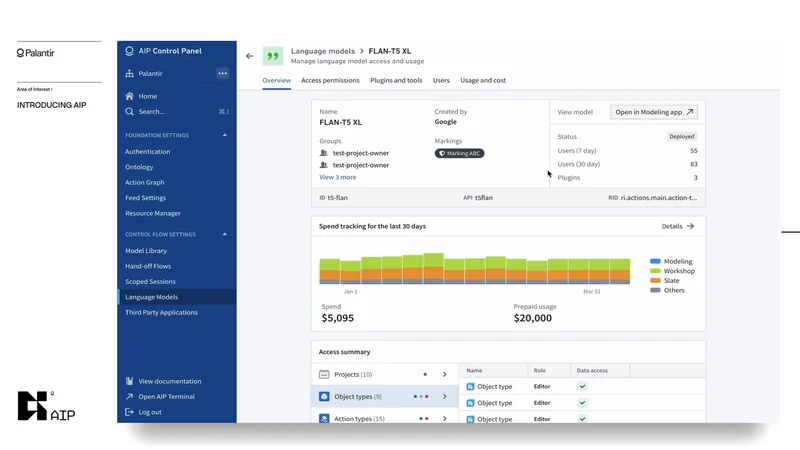
Let’s break this down. On one side, you have Palantir. Forget the mystique for a second and focus on what they actually do. Their core technology, the Palantir Ontology, creates a digital replica of an organization—in simpler terms, it builds a complete, interconnected map of everything from a single screw in a warehouse to a delivery truck on the highway. It takes the chaotic mess of an enterprise’s data and weaves it into a coherent, virtual universe where every object, relationship, and action is understood. For years, this has been an incredibly powerful tool for human decision-making. But it was still a tool. A map, no matter how detailed, needs someone to read it.
Now, enter NVIDIA. NVIDIA isn’t just bringing processors to the party; they're bringing the spark of life. By integrating their CUDA-X libraries, their AI Enterprise platform, and their Nemotron open AI models directly into Palantir’s Ontology, they’re transforming that map into a living world.
Think of it like this: Palantir built a stunningly accurate, life-size model of the human body, with every bone, muscle, and vein perfectly in place. But it was still just a mannequin. NVIDIA is the force that infuses it with a nervous system, allowing it to feel, and a brain, allowing it to think.
Look at the first pioneer here: Lowe’s. They’re using this new stack to build a digital replica of their global supply chain. This isn't about finding a slightly better shipping route. This is about creating a system that can sense a tiny fluctuation in demand for patio furniture in Phoenix and automatically model the ripple effects across the entire global network—from the factory in Vietnam to the freighter crossing the Pacific to the last-mile delivery truck in Arizona—and then take action to optimize it all before a human even notices a problem. This means a system can anticipate disruptions, model solutions in real-time, and execute complex decisions automatically—it's a level of dynamic intelligence that moves beyond human capability and into the realm of true operational autonomy.
The Engine of Tomorrow's World
Once you grasp the Lowe’s example, your mind starts racing. If you can do this for a supply chain, what can’t you do it for? Imagine a hospital system whose digital twin anticipates a flu outbreak based on early data, reallocating staff, ordering supplies, and optimizing bed capacity a week before the emergency rooms are overwhelmed. Imagine a city’s operational AI managing the power grid, traffic flow, and emergency services in real-time during a natural disaster.
I can almost picture the scene in a future command center: not frantic people on phones, but a calm team overseeing a vast digital map where AI agents, like tireless digital shepherds, are already rerouting resources around a crisis that's still just a whisper on the horizon. This is the kind of breakthrough that reminds me why I got into this field in the first place.
This shift feels as fundamental as the invention of the printing press. The press didn't just give us more books; it democratized access to information and changed the very structure of society. This Palantir-NVIDIA stack isn't just giving us better analytics; it’s creating a new kind of cognitive engine that can power our most critical systems. It’s a new source of decision-making power.
Of course, with great power comes immense responsibility. We’re building systems that will operate at a scale and speed that defy human intuition. But what does it truly mean when our core infrastructure starts to think for itself? How do we design these systems to align with human values, ensuring they serve us and not just a cold, calculated logic of pure efficiency? These aren't just technical questions; they are deeply philosophical ones we must start asking now, at the very beginning.
The pieces are all falling into place. Palantir’s mature, battle-tested data-weaving platform, NVIDIA’s universally powerful AI hardware like the coming Blackwell architecture, and the open models that allow for rapid development of specialized AI agents. This isn't a speculative future. The workshop is already scheduled for GTC Washington, D.C. The engine is being built right now.
We're Not Just Predicting the Future Anymore
This is the moment we stop using data to simply look backward. For decades, business intelligence has been about creating a clearer rearview mirror. This alliance is about building a windshield that is also a super-intelligent navigator, one that not only sees the road ahead but can also model a thousand alternate routes in a split second to find the best possible path forward. We are moving from reactive analysis to proactive creation. The digital twin is no longer a mirror of what is; it's becoming a sandbox for what could be—a place to design a better, more efficient, and more resilient reality, and then deploy it into the world. We aren’t just trying to predict the future anymore. We’re starting to build it.