


On Saturday, September 27, an experiment was conducted on the streets of Newcastle. Like any good experiment, it had a hypothesis, a methodology, and it produced a clear set of results. The hypothesis, put forward by political entities UKIP and Advance UK, was that Newcastle upon Tyne, a city they’d labeled the “symbolic heart of Brexit,” was fertile ground for a message of anti-immigration and mass deportations.
The methodology was a street march. The results, however, appear to represent a categorical refutation of the initial premise.
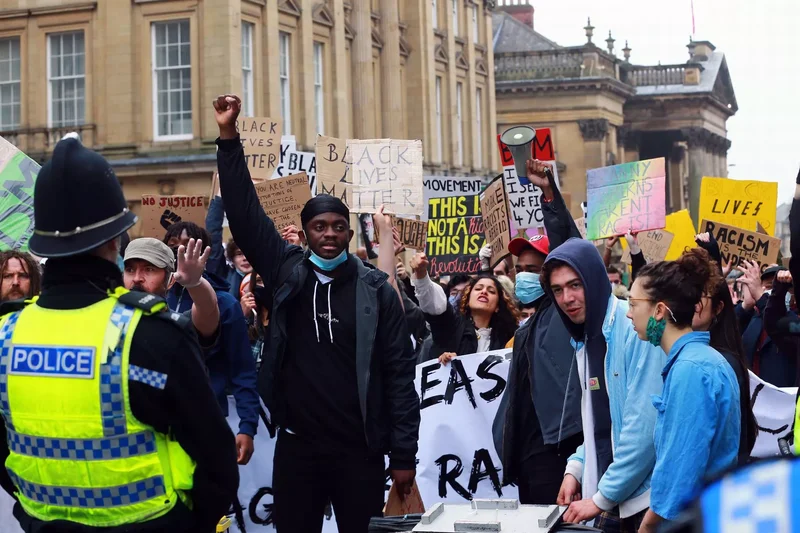
The core of any analysis is the numbers. The UKIP-led protest, which began its march from the Quayside law courts, drew a crowd estimated at between 100 and 200 individuals. To be more exact, most reports converge on the lower end of that spectrum. This was the test group. Simultaneously, a control group—or in this case, a counter-protest—materialized. While precise figures for this second group are unavailable (a common issue with organic, multi-location gatherings), all qualitative and observational data indicate it was substantially larger. The counter-protest was not a single entity but a distributed network, with concentrations at Grey's Monument, Dean Street, and near the City Library.
The initial test parameters had to be altered in real time. The UKIP march’s planned route up Dean Street was blocked by the larger counter-demonstration, forcing a diversion onto Mosley Street. From an analytical perspective, this is the first indicator of a failed projection. An organization unable to command its chosen territory, even for a short-term event, has fundamentally misjudged the operational environment. Northumbria Police, including mounted units, were deployed to manage the interface between the two data sets, forming lines on Mosley and John Dobson Streets. The day’s event concluded with three arrests for breach of the peace. A statistically minor figure, suggesting the police intervention was effective in preventing a more chaotic interaction.
A Stress Test for a Flawed Narrative
An Analysis of Competing Narratives
This event did not occur in a vacuum. It was preceded by the cancellation of a conference for Advance UK, a new party led by Ben Habib and reportedly backed by figures like Tommy Robinson and Elon Musk. The venue, the Crowne Plaza hotel (which is owned by Newcastle City Council), cited “health and safety” grounds for the cancellation. This action, and the preceding statement from North East Mayor Kim McGuinness that the group did not “belong” in the region, established a clear institutional position before the street-level experiment even began.
The core discrepancy lies in Advance UK’s initial framing of the city. Labeling Newcastle the “symbolic heart of Brexit” is a powerful piece of marketing, but it collides with a stubborn fact: the city voted to remain in the European Union. This isn’t a minor detail; it’s the fundamental dataset of public sentiment on the very issue at hand. To ignore it is not just an oversight, it's a profound analytical failure.
I’ve looked at hundreds of corporate prospectuses and market-entry strategies, and this particular miscalculation is striking. It’s akin to launching a new line of arctic parkas in the Sahara based on a single, uncorroborated report about a cold evening. The on-the-ground reaction on Saturday was the market correcting the flawed prospectus in real time.
The messaging from the counter-protest provides a qualitative insight into the local sentiment. Signs with slogans like “Geordies are Black and White” and “refugees welcome” are anecdotal, but their volume and consistency, coupled with the sheer numerical superiority of the crowd holding them, form a coherent data pattern. This pattern was then officially endorsed. The presence of both Mayor Kim McGuinness and Council Leader Karen Kilgour at the counter-protest is a significant data point. It represents the alignment of the city’s elected leadership with the larger of the two public factions.
McGuinness described feeling “proud,” stating the numerical disparity “just goes to show what this city and region is all about.” Kilgour’s statement was even more direct, framing the anti-immigration message as antithetical to the city’s values of “love, unity and kindness.” She explicitly co-opted the football-related slogan, describing Newcastle as “a city of black and white... a city that will always be united.” These are not just political platitudes; in this context, they are a formal summary of the day’s observable outcome. The leadership looked at the competing crowd sizes and declared a winner.
Of course, we must apply a methodological critique. Crowd estimation is an imprecise science, often influenced by the observer’s own biases. Police forces have largely stopped providing official figures for this very reason. But the requirement for the UKIP march to be rerouted, the heavy police presence required to keep a smaller group separate from a larger one, and the consistent media portrayal of one group dwarfing the other all serve as corroborating evidence. The precise ratio is less important than the undeniable order of magnitude. One group was significantly, visibly larger than the other.
The experiment, then, is conclusive. A political narrative was stress-tested against public opinion in a controlled, observable environment. The narrative failed to find its projected market.
A Failed Market Test
The events in Newcastle were not fundamentally about politics or ideology. They were about data. One group operated on a narrative that was demonstrably false according to verified electoral results. They projected a level of support that failed to materialize. When their hypothesis was tested on the streets, the market—the people of the city—returned a clear, unambiguous verdict. The attempt to sell Newcastle a self-image it had already publicly rejected was a strategic error. The low turnout for the march and the overwhelming counter-protest were not just a demonstration; they were the definitive, final trading figures on a bad investment.
Reference article source: