


When you look up at the night sky, what do you see? Stars, planets, maybe the faint smear of the Milky Way. For centuries, we saw it as a beautiful, but largely static, backdrop. We were the protagonists on a lonely stage. But that story is changing, faster than any of us could have imagined. The universe, it turns out, isn’t just out there—it’s actively visiting. And its latest messenger, a comet named 3I/ATLAS, is carrying a note that has left scientists absolutely breathless.
This isn’t just another rock hurtling through the void. This is a piece of another solar system. When I first read the pre-print paper detailing its composition, I honestly just sat back in my chair, speechless. Forget alien radio signals. This is a physical object, a tangible piece of a world born around another star, and it’s telling us that the universe is far stranger and more wonderful than our models ever predicted.
A Chemical Fingerprint We've Never Seen
Let's get into the heart of it. Comets are essentially dirty snowballs, leftovers from the formation of a solar system. As they get close to a star, the ice turns directly into gas—a process called sublimation—creating a glowing cloud around the nucleus known as a coma. Think of it as the comet’s atmosphere. We’ve studied the comas of comets in our own solar system for decades, and we have a pretty good idea of what they’re made of: water, dust, and trace amounts of various elements, including iron and nickel.
But 3I/ATLAS is different. A new study revealed that the Interstellar Comet 3I/ATLAS Found To Have "Extreme Abundance Ratio" Of Iron And Nickel. This isn't a small deviation; researchers called the finding itself "extremely puzzling."
Now, why is this so mind-bending? Because the surface of 3I/ATLAS is far too cold for rocks containing iron and nickel to just vaporize. It’s like finding a puddle of melted steel on an Antarctic glacier. It just doesn’t make sense with what we know. This is the kind of breakthrough that reminds me why I got into this field in the first place—it’s a genuine, Grade-A mystery. What kind of stellar nursery forges objects like this? Are we looking at a fragment of something truly exotic, a piece of a planetesimal from a system with a chemistry completely alien to our own?
The previous interstellar visitor we got a good look at, 2I/Borisov, was, frankly, a bit boring. It looked a lot like our own comets, which was cool in its own way—it suggested the basic ingredients for solar systems might be universal. But 3I/ATLAS just smashed that idea to pieces. It’s like we’ve been studying different types of bread from around the world, and just as we’re concluding they’re all made from wheat, someone hands us a loaf made of glowing crystals.
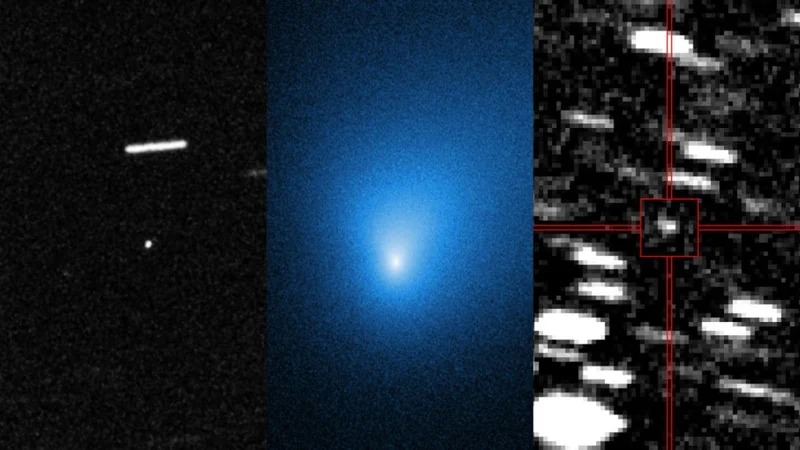
More Than a Comet, It's a Geological Sample
I want you to reframe how you think about this. Stop seeing 3I/ATLAS as just a comet. Start seeing it as a probe. It’s a geological sample from an unknown star system, delivered right to our cosmic doorstep with no launch costs. It's traveling at an insane velocity, nearly twice that of our previous interstellar guests, meaning it has journeyed for an unimaginable amount of time across the vast emptiness between stars, and the fact that it’s here and we can study its makeup is a gift of cosmic proportions that could rewrite entire textbooks.
This is a paradigm shift. Think about it. For all of human history, our study of exoplanetary systems has been indirect, based on the faint dimming of starlight or the subtle wobble of a distant sun. It’s all been educated guesswork from trillions of miles away. But 3I/ATLAS is a direct sample. It’s the equivalent of a Martian rock landing in your backyard.
This is our Galileo moment. When he first pointed his telescope at Jupiter, he didn’t just see another point of light; he saw moons orbiting it. That single observation shattered the idea that everything revolved around the Earth and fundamentally altered our place in the universe. This comet’s bizarre chemical signature could do the same for our understanding of planetary science. It forces us to ask bigger questions. If the building blocks are this different, how different are the worlds they build? What kinds of planets—and what possibilities for life—exist in a system that produces objects so rich in these specific heavy metals?
Of course, with such a profound discovery comes a responsibility to be rigorous and humble. The data is new, the paper isn’t yet peer-reviewed, and there are huge gaps in our knowledge. The comet is currently out of view, hidden by the glare of the Sun, and there’s a chance it was even struck by a blast of solar plasma. We’re all holding our breath, waiting for it to emerge later this year, hoping we can get another look. But the questions it has raised will echo in labs and universities for years, regardless.
The Universe Just Ripped Up the Rulebook
For a long time, we’ve operated under the assumption that the laws of physics and chemistry are the same everywhere. And they are. But 3I/ATLAS is a stunning reminder that while the rules are the same, the outcomes can be wildly, beautifully, and unpredictably different. We had a tidy little story about how solar systems form. This comet just arrived like a guest at a dinner party who calmly informs everyone that everything they think they know about cooking is wrong.
It’s a humbling, exhilarating feeling. We are not at the end of discovery; we are, and perhaps always will be, at the very beginning. This little visitor from another star didn’t bring answers. It brought something far more valuable: better, bigger, and more profound questions. And as we wait for it to swing back into view, one thing is certain—the cosmos just got a whole lot more interesting.