


# JPMorgan’s Paradox: Why a Stellar Report Card Spooked Wall Street
On paper, it was a textbook victory. A grand slam. JPMorgan Chase, the titan of American finance, stepped up to the plate on Tuesday and delivered a Q3 earnings report that should have sent champagne corks flying. An earnings per share of $5.07, shattering Wall Street’s expectations. A stunning 16% jump from the same time last year. By every traditional metric we use to measure success, this was a company firing on all cylinders.
And yet, the market yawned. Worse than yawned, it flinched. The stock price dipped.
The chatter on financial news was the usual mix of muted confusion and expert hand-wringing about guidance and macroeconomic headwinds. But I think they’re all missing the point. Completely. When I saw the ticker drop after those numbers came out, I didn’t feel confused. I honestly felt a jolt of recognition. This is it. This is the moment the future starts sending us signals the present can’t quite decipher yet.
What if the market’s reaction wasn’t irrational? What if it was instinctual? What if, deep in its silicon soul, the global financial machine is sensing a fundamental shift on the horizon, a change so profound that even a record-breaking quarter feels… irrelevant?
The Last Perfect Steam Engine
To understand what’s happening, we need to stop looking at JPMorgan as just a bank and start seeing it as a system. It is arguably the most sophisticated, efficient, and powerful version of the 20th-century financial operating system ever built. Its Q3 earnings are a testament to that—a masterpiece of optimization.
But what happens when a new operating system is being written?
Think of it like this: JPM is the world’s greatest manufacturer of steam engines in the year 1910. They have just unveiled their masterpiece—it’s more powerful, more efficient, and more reliable than any steam engine ever created. The craftsmanship is breathtaking. And yet, across town, a little company called Ford is quietly perfecting a noisy, strange new contraption called the internal combustion engine. The market doesn't fully understand the new engine yet, but it can hear the rumble. It senses that the very definition of "transportation" is about to change forever.
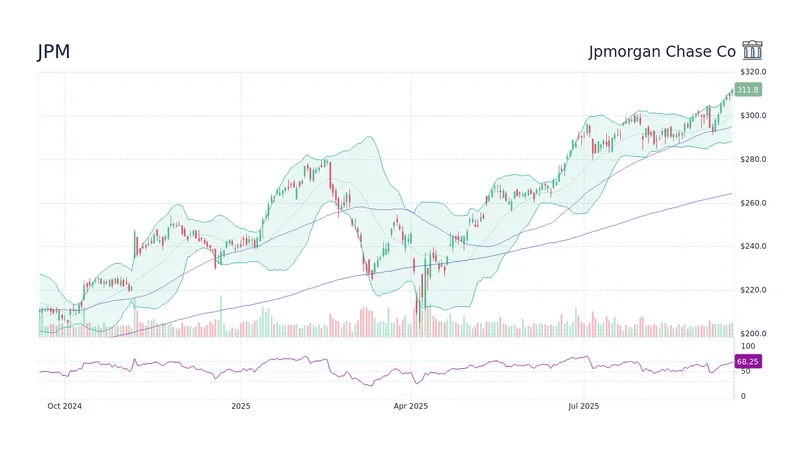
Does that make the perfect steam engine worthless? No, not overnight. But its peak value is now in the rearview mirror. The stock drop wasn’t a judgment on JPM’s Q3 performance; it was a subconscious acknowledgment that the game itself is changing. The market is pricing in not a failure of execution, but a potential obsolescence of the entire model. How do you value the world’s best horse-drawn carriage on the day the Model T becomes affordable?
A New Financial Physics
So what is this new engine? It’s not one single thing, but a confluence of technologies that are converging to rewrite the rules of value itself. We’re talking about the maturation of decentralized finance—or DeFi, which in simple terms, is the idea of building a financial system on open, transparent networks, like the internet itself, instead of inside the walled gardens of today’s megabanks.
This isn’t some fringe concept anymore. It’s a parallel financial universe being built in real-time, one that allows for programmable money, automated markets, and near-instantaneous global settlement without a dozen intermediaries each taking a slice. It’s a shift from a world of institutional trust to a world of mathematical certainty.
When you add a mature, reasoning AI into that mix, capable of managing assets and underwriting risk with a complexity no human team could ever match, you don’t just get a faster version of the old system. You get a new financial physics. The very atoms of banking—trust, settlement, and capital allocation—are being split and reconfigured.
This is the kind of breakthrough that reminds me why I got into this field in the first place. Imagine a world where value moves as freely and instantly as information does today—a world where your mortgage isn't a 300-page document but a self-executing smart contract, where international payments don't take days but seconds, and where access to capital is determined by the quality of your idea, not the zip code you were born in. That’s the promise. That’s the rumble the market hears. It begs the question: What role does a traditional bank, even a great one, play in a world like that?
Of course, with this power comes immense responsibility. We can't just rebuild the old system with new technology; we have to build a better, more transparent, and more equitable one. This transition will be messy and fraught with challenges, but standing still isn't an option. The future doesn't ask for permission.
The Tremor Before the Earthquake
So, no, I don't see JPMorgan's stock dip as a sign of failure. I see it as one of the most exciting and hopeful signals I've seen in years. It’s a sign that the market is finally, albeit clumsily, waking up. It's the tremor that precedes the earthquake, the quiet moment of realization before the paradigm shift.
JPMorgan isn't a dinosaur. It's a giant at a crossroads. It has the capital, the talent, and the global reach to stop building better steam engines and start designing the next generation of vehicles. The question is no longer "How much profit did you make this quarter?" The real question, the one that truly matters for the next century, is "What are you building for the next one?" That's the story the numbers can't tell you. But it's the only one that matters now.