


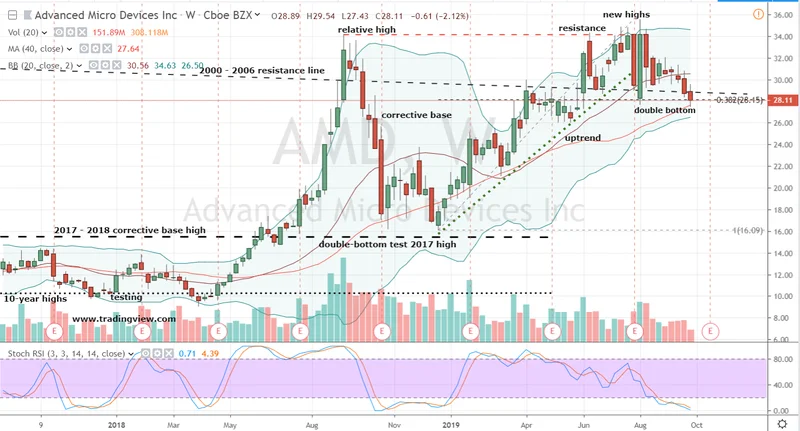
It’s easy to look at the ticker today and feel a knot in your stomach. The screen is a sea of red. AMD’s stock price is down, and the headlines are buzzing with talk of falling profits and geopolitical headwinds. The immediate reaction—the human reaction—is to see a company stumbling, to feel the cold prickle of doubt.
But I’m asking you to do something else. I want you to look past the noise, beyond the day-to-day gyration of the market, and see the powerful, undeniable signal that’s pulsing just beneath the surface. Because what’s happening with AMD isn’t a story of decline. It’s a story about a technological titan being temporarily obscured by a political storm cloud, and the market is completely missing the point.
This is the kind of moment that reminds me why I got into this field in the first place. It’s in these moments of confusion that the future becomes visible to those willing to look.
The Signal Through the Noise
Let’s get right to the heart of it: the second-quarter earnings report. On the surface, the numbers look jarring. A 29% drop in adjusted operating profit? A 30% slide in earnings per share? These are the figures that send skittish investors running for the exits. But they don’t tell the story. They are the result of the story.
The real story is buried in a single line item: an $800 million inventory-related charge.
The company took this massive charge because of U.S. export restrictions on its cutting-edge Instinct MI308 AI chips to China. In simpler terms, they had to write off a colossal amount of brilliant technology they had built but were suddenly forbidden to sell due to a government directive. This wasn't a miscalculation of demand or a failure of their product. It was a political wrench thrown into a high-performance engine.
When I dug into the numbers and saw that AMD’s adjusted gross margin would have been a staggering 54% without that charge, I honestly just sat back in my chair. Fifty-four percent. That’s not a company in trouble; that’s a coiled spring. That’s a testament to incredible efficiency and product value. The market is punishing AMD for a geopolitical event as if it were a fundamental business failure, and it’s one of the most short-sighted analyses I’ve seen in a long time.
While the profit numbers were skewed by this one-time event, look at what wasn't: revenue. AMD still pulled in $7.7 billion, a 32% increase from the year before. Let that sink in. In a world grappling with supply chains and global uncertainty, the demand for their technology is exploding. So, what are we really looking at here? A company whose core business is firing on all cylinders but had to pay a one-time political tax. Is that a reason to doubt its future, or is it a temporary drag on a rocket that’s already cleared the launchpad?
The Innovation Race Isn't a Monopoly
For years, the conversation around high-performance computing has been dominated by one name: Nvidia. And for good reason. The performance of `nvidia stock` reflects a company that has masterfully captured the first wave of the AI revolution. But we have to stop thinking about this incredible technological frontier as a simple, zero-sum game.
This isn't a 100-meter dash with a single gold medalist. The AI revolution is more like the birth of the automotive industry. In the early 20th century, it wasn't just about one company. It was about a Cambrian explosion of innovation from Ford, General Motors, Chrysler, and countless others, each pushing the boundaries of what was possible. That competition is what gave us the modern world. It made cars better, cheaper, and more accessible for everyone.
That is exactly what we are witnessing now. AMD isn't just a competitor to Nvidia or `intel stock`; it is a necessary catalyst for the entire ecosystem. And the market’s current valuation of these two titans is fascinating. While the `nvda stock price` reflects a company priced for near perfection, trading at 15.8 times its next year's revenue, the `amd share price` sits at a multiple of just 6.4. The market is essentially saying it has more than twice the faith in Nvidia's future growth than in AMD's.
Is that rational, given AMD’s underlying performance? Does it make sense when you realize that having two fierce competitors at the absolute cutting edge is the single greatest accelerator for progress? This isn't just about two companies fighting for market share it's about the very fabric of our future being woven at an exponential rate and that kind of competition is the rocket fuel that will get us to the next paradigm shift faster than any of us can imagine. It also places a profound responsibility on their shoulders to build this future ethically and with humanity at its core. But the race itself? It’s the most exciting thing happening in technology today. (Is AMD Stock Your Ticket to Becoming a Millionaire?)
The Real Moat is Momentum
So, let's circle back to that falling `amd stock price today`. You can see it as a sign of weakness, or you can see it for what it is: a disconnect between a temporary political headline and a deep, powerful technological current. The market is pricing in the fear of today, not the reality of tomorrow. The $800 million charge is a ghost—a phantom of a past decision that has no bearing on the next chip AMD designs or the next breakthrough it achieves.
The true moat of a technology company isn't its current profit margin or its stock valuation. It's the relentless, unceasing momentum of its innovation. It’s the talent it attracts, the problems it solves, and the vision it has for what’s next. By that measure, AMD isn't just surviving; it’s accelerating. The future isn't being built by one company in a vacuum. It’s being forged in the fiery competition between titans, and we are all going to be the beneficiaries.