


The data points from Parkersburg, West Virginia, are straightforward. From Wednesday to Saturday, Trinity Episcopal Church will conduct its 75th annual Used Book Sale at Trinity Hall on Juliana Street. The hours of operation are fixed: 9 a.m. to 6 p.m. for the first three days, concluding with a 9 a.m. to noon session on Saturday. The explicit goal is to convert donated books into funding for a portfolio of community outreach programs, including food assistance and choir scholarships.
This is a familiar model of localized, community-facing activity. The event's marketing materials promise books that "entertain, instruct, or inspire," a broad and inclusive value proposition. A volunteer, Donna Coleman, provided a quote that reveals a surprisingly methodical pricing strategy. "We researched the books for rarity and value," she stated, before noting, "Then we discounted the actual market value to make these books more competitively priced for our Mid-Ohio Valley customers." This isn't just a bake sale; it's a micro-enterprise with a defined market and a clear discounting model. For only the second time in the sale’s 75-year history, a door prize is being offered—a copy of Gregory Maguire's "Wicked"—an outlier in the event's long-term operational data.
This pattern of hyper-local engagement is not an isolated incident. In another part of the country, St. Mark’s and St. Luke’s Episcopal churches are co-hosting a Blessing of the Animals service. The event is open to all community members, a strategically low barrier to entry. The logistics are planned with contingencies (an outdoor park is the primary location, with St. Luke's church as the rain site), and the invitation is inclusive, extending to photos of pets or even just memories of them. Further south, the Episcopal Church of the Good Shepherd in north Dallas is seeking a Senior Associate, describing itself in recruitment materials as a "dynamic, friendly parish" focused on "authentic community."
Considered together, these individual events form a coherent, qualitative data set. They paint a picture of The Episcopal Church as a network of community hubs. Each parish, from Trinity Episcopal Church to St. John's Episcopal Church, appears to function as a semi-autonomous node, executing on-the-ground initiatives tailored to its specific geography. The public-facing narrative is one of service, inclusion, and local fellowship. This is the brand.
Local Wins, National Lag: The Inevitable Math of a Federated Model
An Examination of Institutional Metrics
But a separate set of data points suggests a different, more complex structural reality operating beneath this surface-level narrative. When we shift from observing local parish activities to analyzing the metrics of the national institution, a significant discrepancy emerges, particularly in comparison to adjacent organizations like the Anglican Church in North America (ACNA).
The most telling metric available is the endorsement of U.S. military chaplains. The ACNA, a more centrally-governed body that separated from The Episcopal Church, endorses 187 chaplains. The Episcopal Church, by contrast, endorses approximately half that number—to be more exact, the 187 figure for the ACNA implies an Episcopal count in the low 90s. This is a quantifiable divergence in institutional projection into a highly structured, national organization.
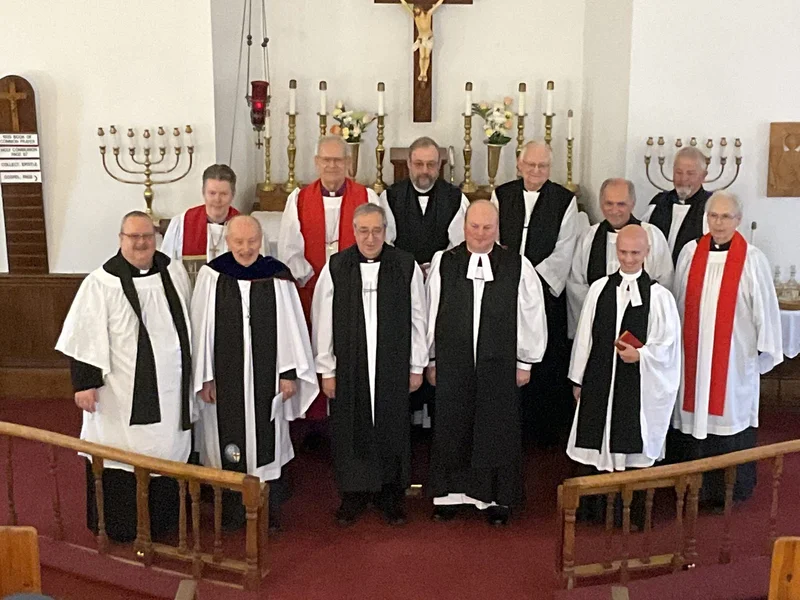
The cause of this discrepancy appears correlated with a fundamental difference in organizational architecture. In The Episcopal Church, chaplains typically maintain canonical residency in their home diocese. This is a decentralized model. Authority and affiliation remain distributed among regional bodies. This contrasts sharply with the ACNA’s formerly centralized structure for managing its chaplains. The operational implications are significant. A federated model, like that of The Episcopal Church, prioritizes local autonomy and relationships. A centralized one prioritizes uniform standards, deployment, and institutional cohesion on a national scale.
I've looked at hundreds of organizational filings and structures, and this particular detail is unusually illuminating. It suggests that The Episcopal Church operates less like a modern corporation with a strong central command and more like a holding company for a diverse portfolio of independent local franchises. The process for clergy transfers from the ACNA reinforces this observation. When a priest leaves the ACNA for The Episcopal Church, the transfer is described as "cordial" and is handled entirely "at the discretion of their diocesan bishop." There is no single, national gatekeeper. Power is distributed to the nodes.
This federated model explains both sets of data. The local book sales and pet blessings are not just marketing; they are the logical output of a structure that empowers local parishes to be the primary interface with the public. The parish, with its 500 communicants and associated school of 600 students, like the one at Good Shepherd in Dallas, is the fundamental unit of the organization. Its successes are its own.
However, this same structure makes it difficult to project unified institutional power, as seen in the chaplaincy numbers. When competing for positions within a rigid external hierarchy like the military, an organization with a distributed, discretionary structure is at a quantitative disadvantage against one with a centralized, streamlined process. The numbers don't suggest failure, but rather a strategic trade-off. The Episcopal Church's structure is optimized for Juliana Street in Parkersburg, not for a central command in Washington D.C.
The public narrative is therefore true, but incomplete. It focuses entirely on the output of the local nodes—the book sales, the community services, the "authentic community"—while remaining silent on the overarching institutional architecture that produces these outcomes. The brand is local, because the structure is local.
A Structural Diagnosis
The observable reality of The Episcopal Church is not a contradiction, but a case of cause and effect. The charming, hyper-local, and community-centric activities are a direct result of a deeply decentralized, federated structure. This model maximizes parish-level autonomy and community connection at the quantifiable cost of centralized institutional influence. The story isn't one of a thriving local church versus a struggling national body; it's the story of a single, consistent strategic choice, where the numbers from the local book sale and the national chaplaincy report are simply two different columns on the same institutional balance sheet.
Reference article source: